Launch offer — valid today only

📄 Digital book in PDF · read it on your phone or print it

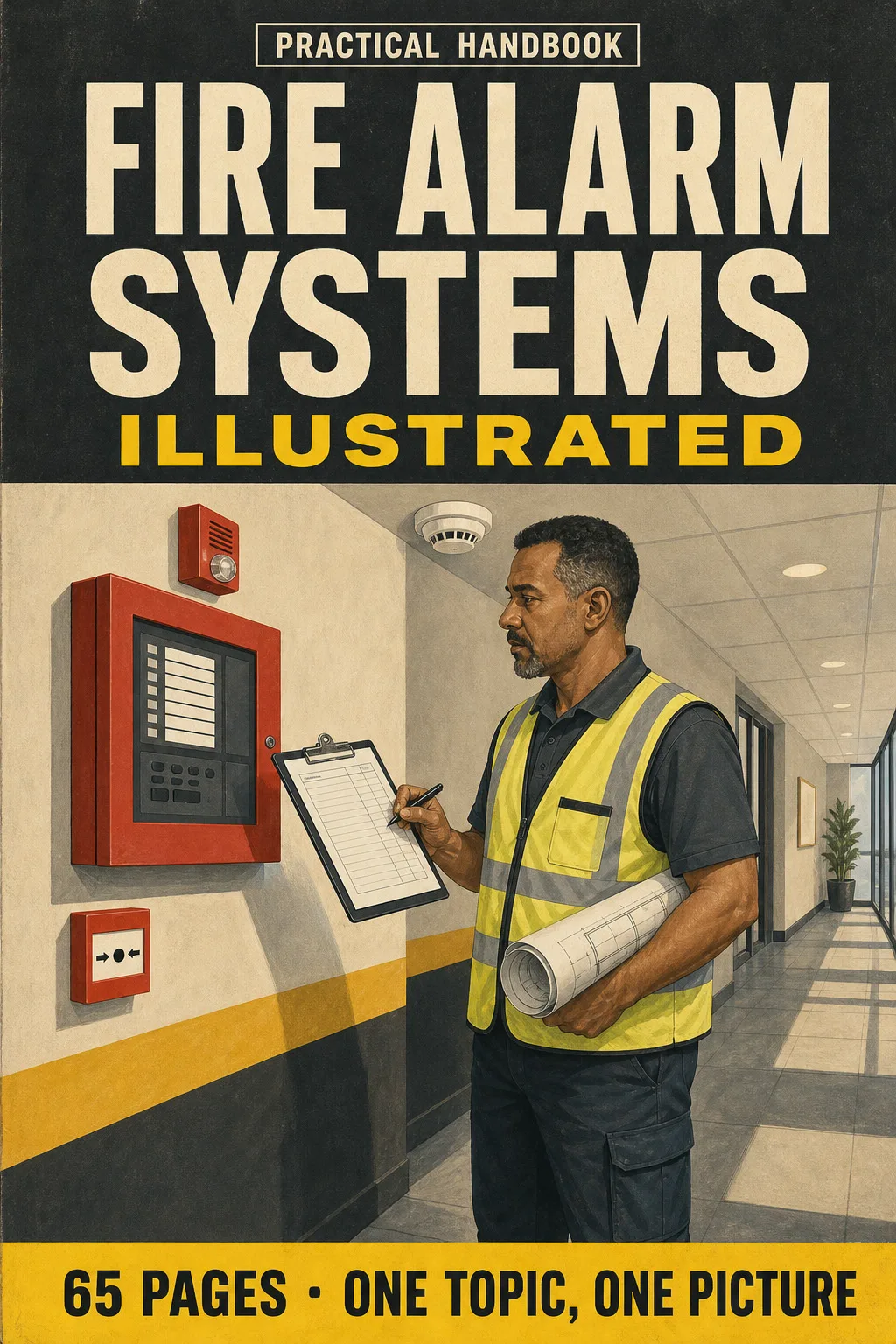
Fire Alarm Systems Illustrated: Layout, Cabling and Fault Finding, All Drawn One Topic on Every Page

Detector choice, the coverage circle, call points, sounders, zones, fire-resistant cable, standby batteries, commissioning and fault finding. Every topic has its own page: the drawing first, then what you need to remember. 65 illustrated pages.

START STUDYING THIS WAY

🔒 Secure checkout · PDF by email · 30-day guarantee

Every topic, its own pageEach SANS 10139 rule drawn with the measurement marked, and the explanation beside it
65 illustrated pages8 parts, from how a fire alarm system thinks to fault finding and revision
Up-to-date sourcesSANS 10139, SANS 10400-T and SANS 322
PDF by emailFormat

Look Inside the Book

Every page has a large drawing and a box with the distances, heights and steps you need to know:

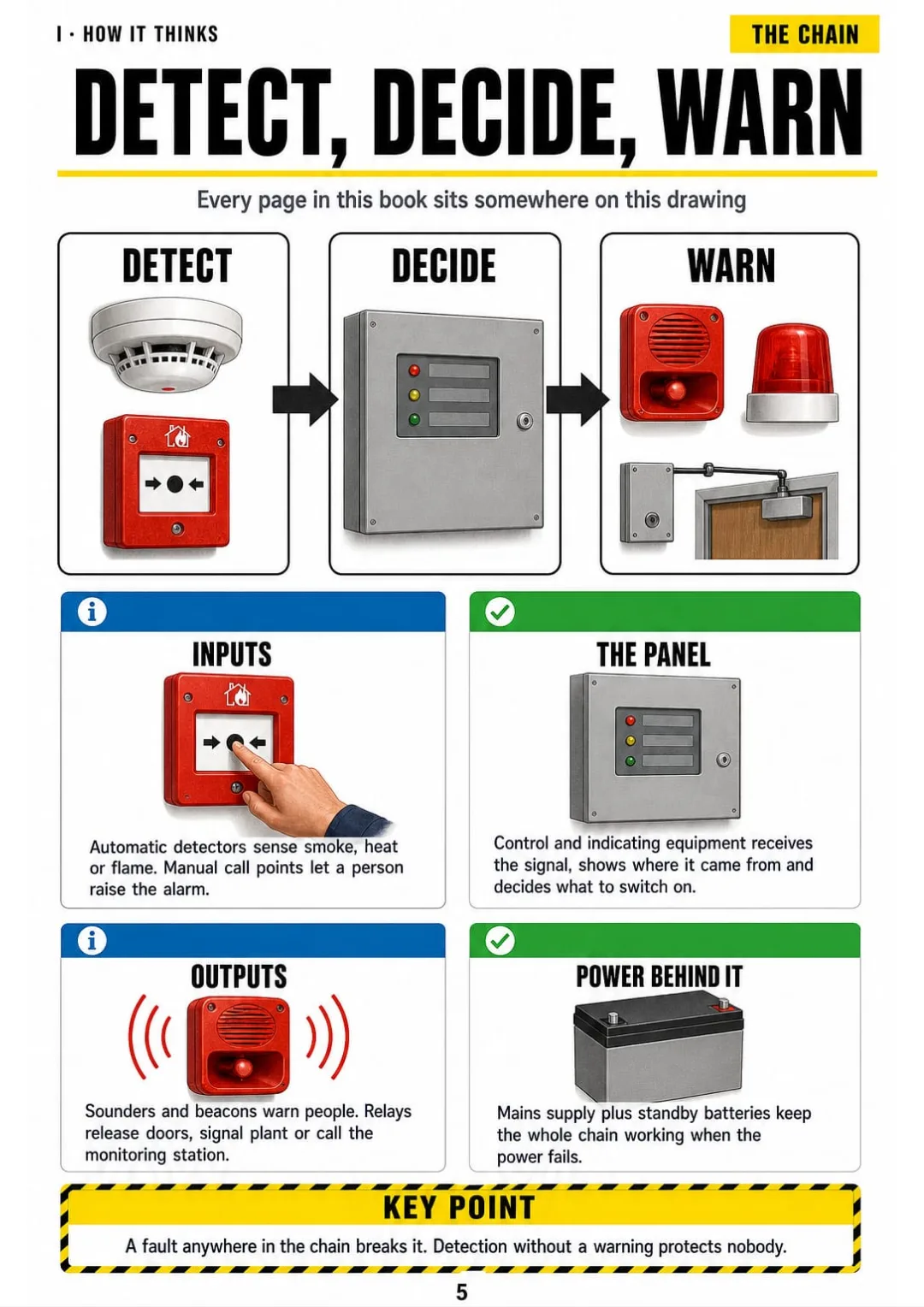
Detector or call point → panel → sounders, beacons and outputs.
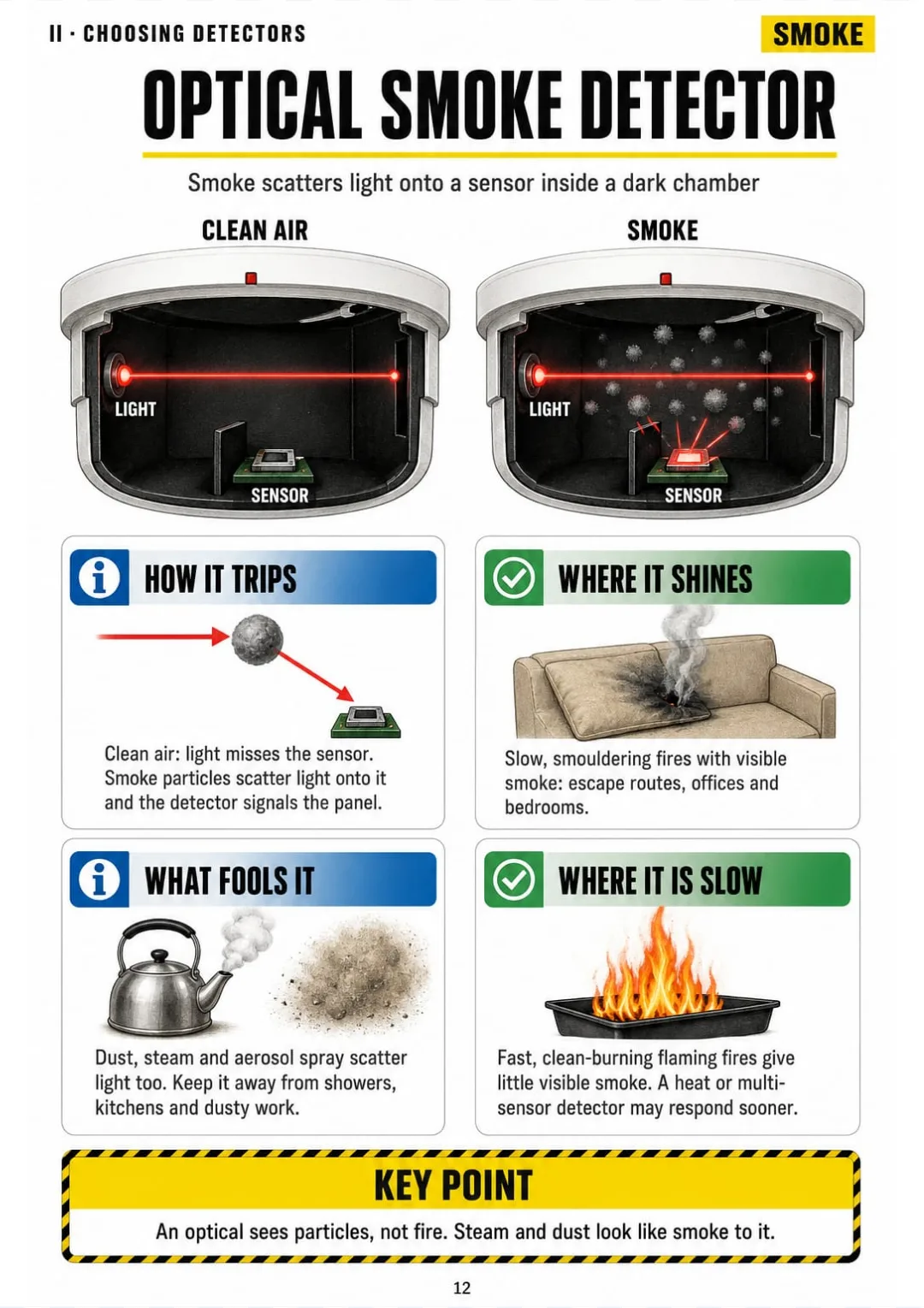
Optical smoke detector: smoke scatters light onto the sensor · best on smouldering fires, slower on clean flaming fires
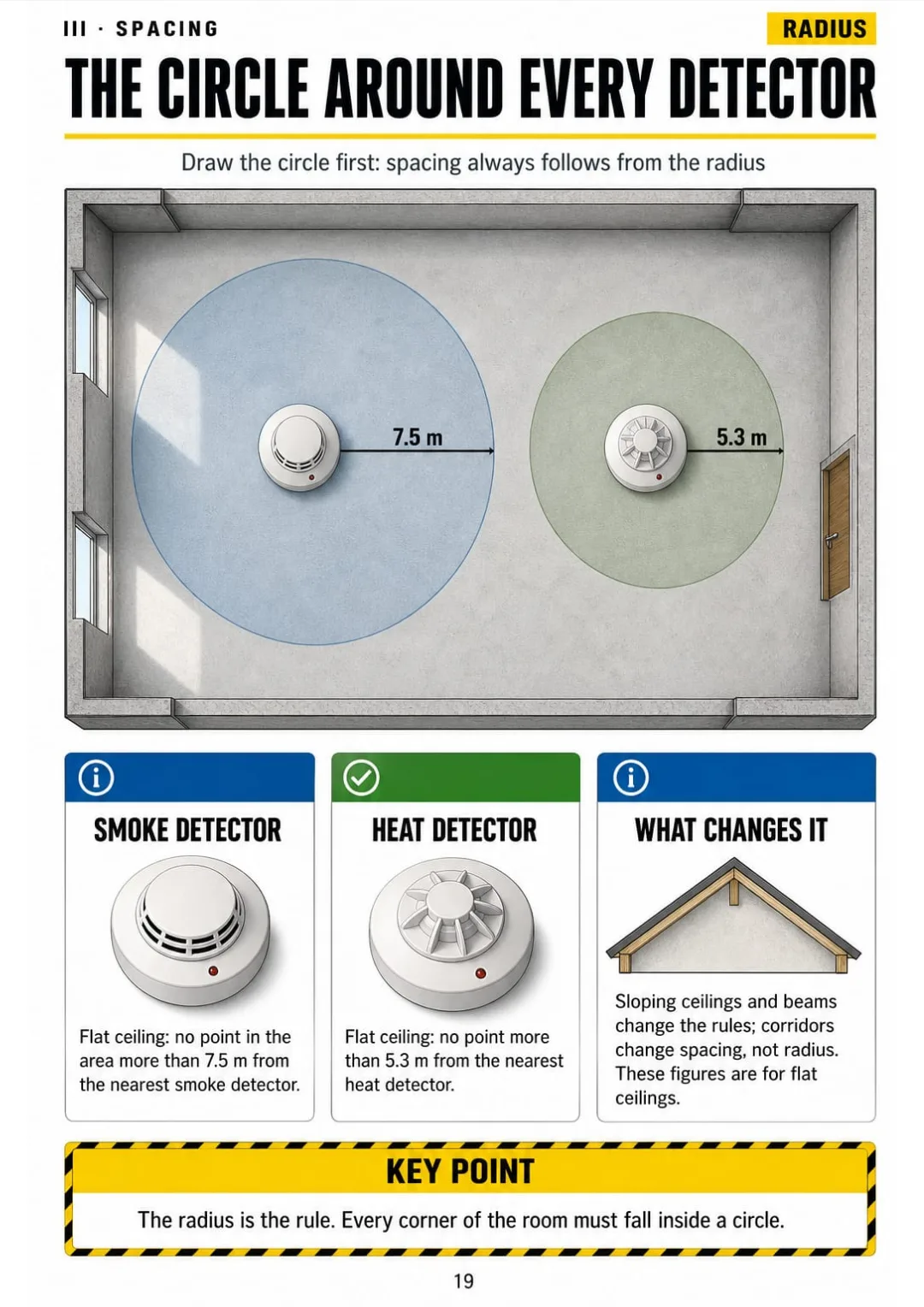
Flat ceiling: 7.5 m radius for smoke, 5.3 m for heat
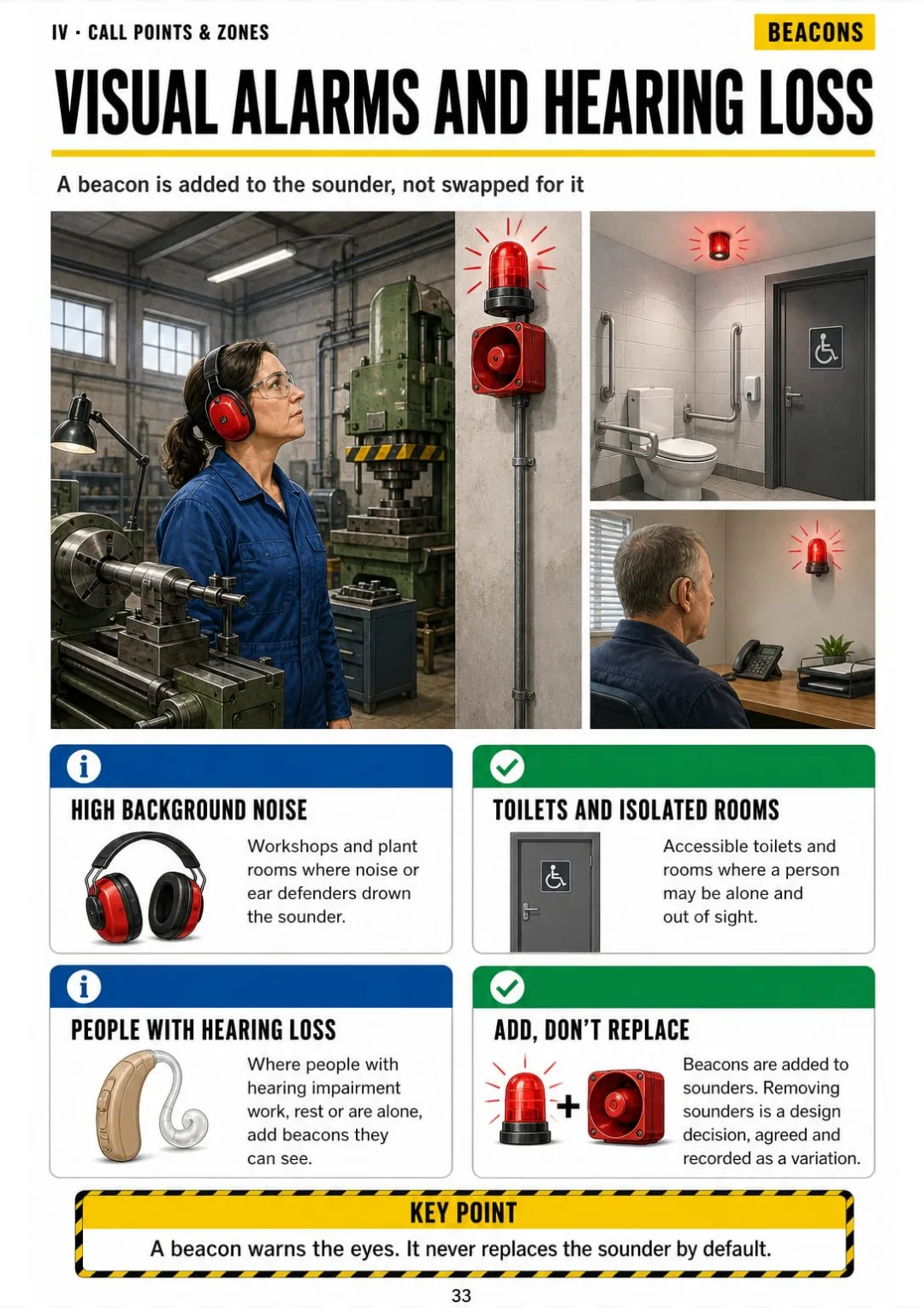
Visual alarm devices: for noisy areas, toilets and people with hearing loss, alongside the sounders.
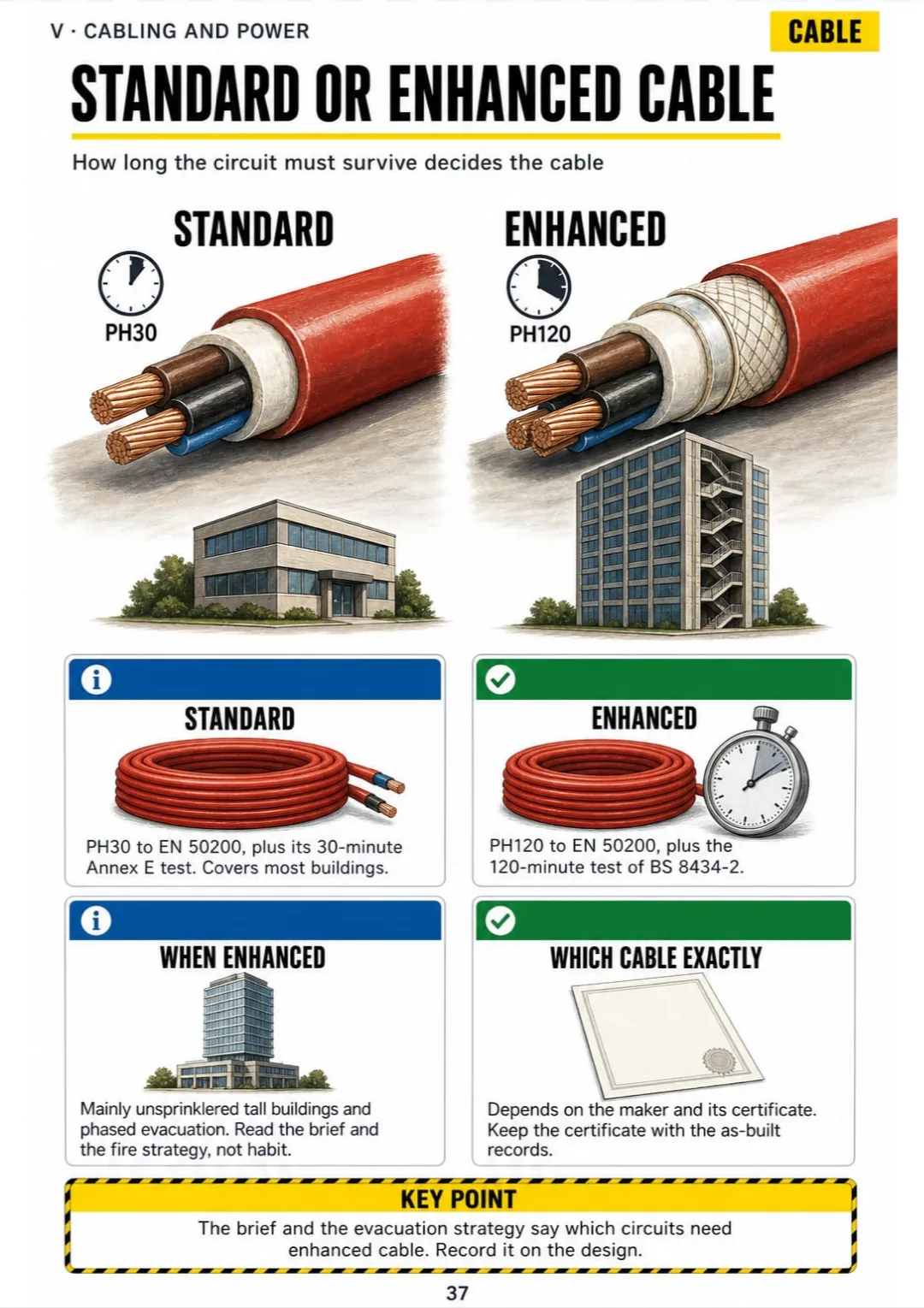
Standard PH30 vs enhanced PH120 fire-resistant cable, and how to tell from the brief
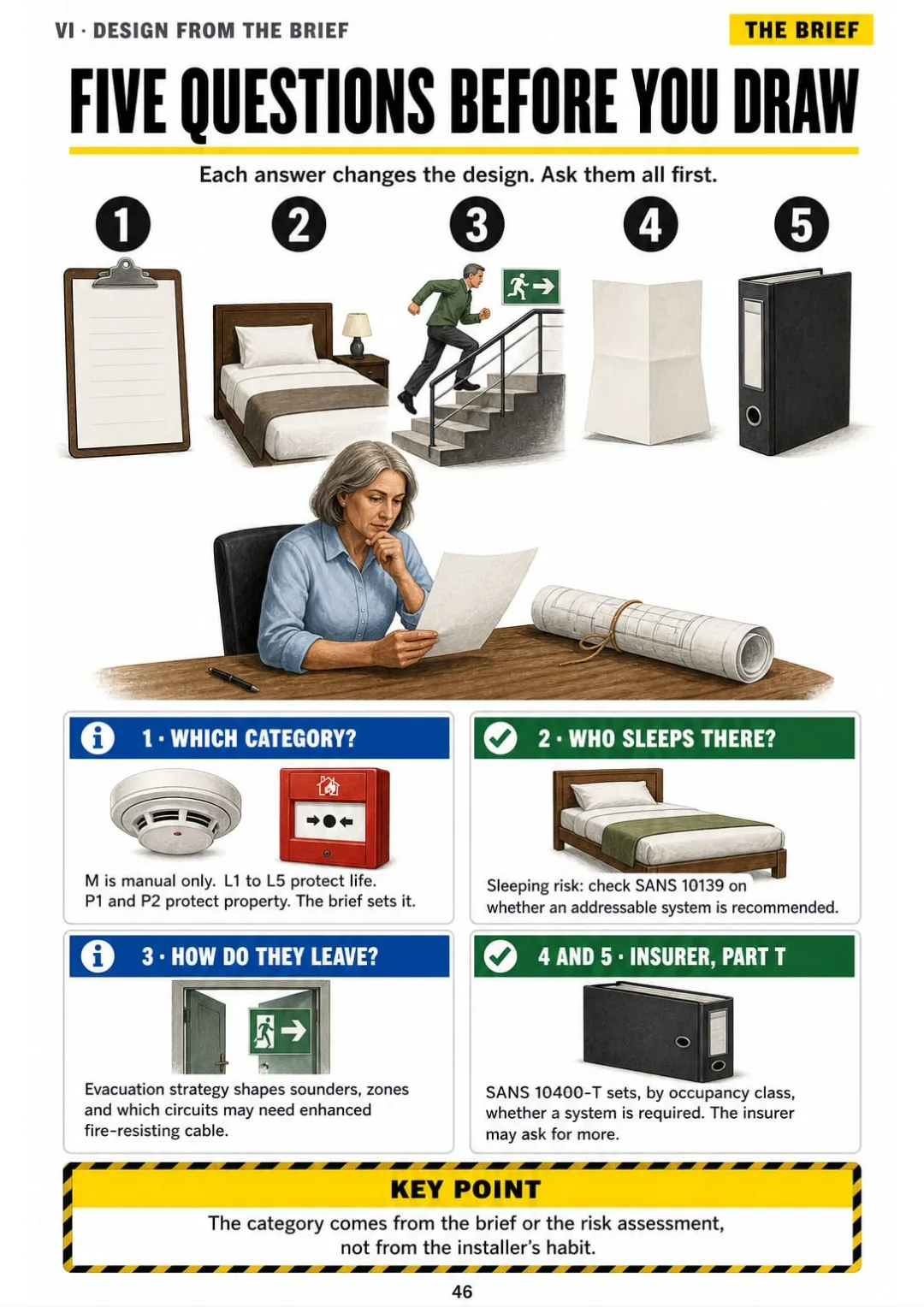
Category, sleeping risk, evacuation, insurer and SANS 10400-T: five answers before the floor plan.
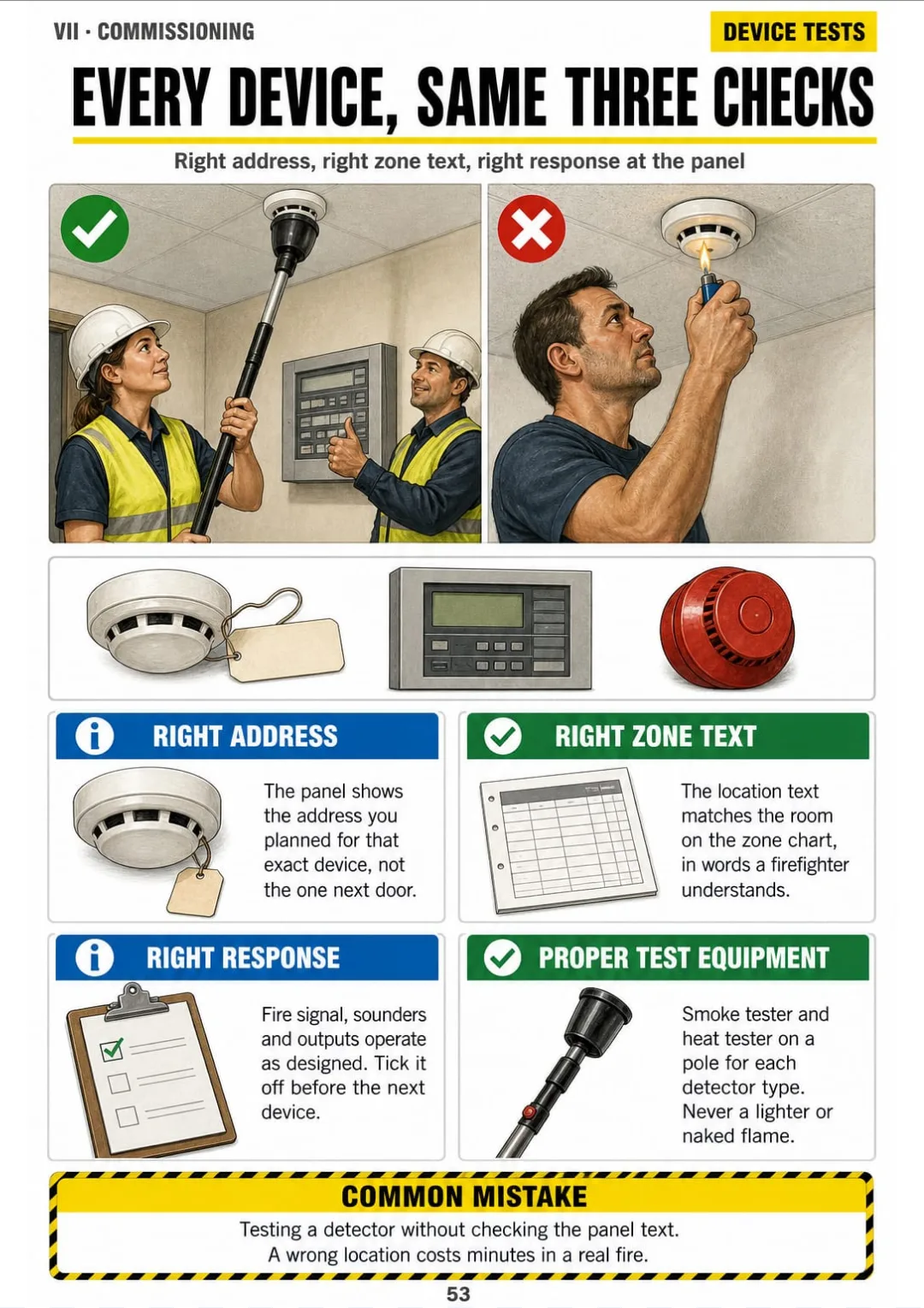
Every device checked for address, zone text and panel response, using proper test equipment.
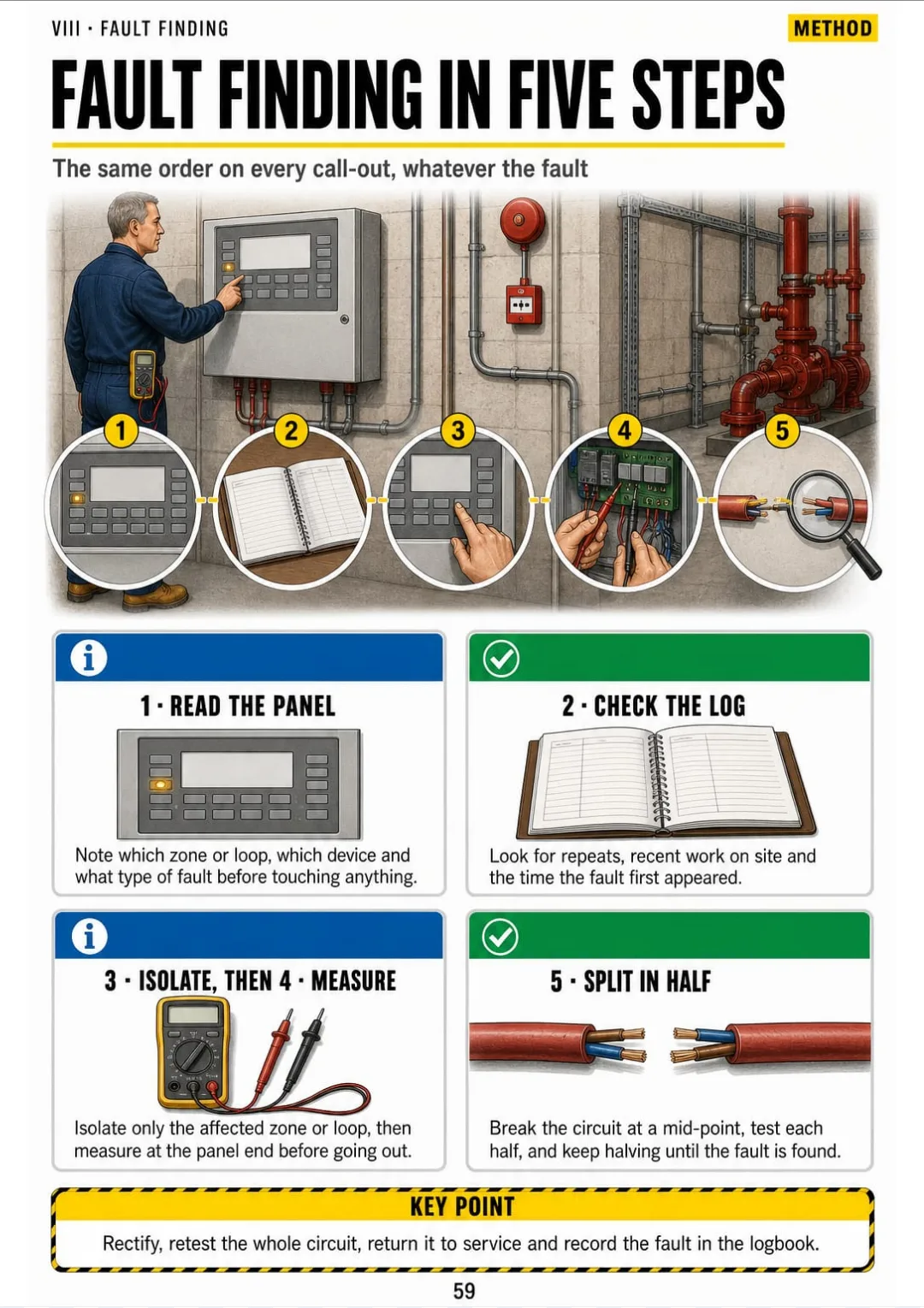
Five steps, always in the same order: panel, log, isolate, measure, split in half.

Swipe to see more →

These are real pages from the book. The table of contents is the full one: 8 parts and 61 topics.

The Problem Isn't You. It's How It Was Explained to You.

You're standing in an open-plan office with the floor plan in your hand, and the client asks how many smoke detectors that ceiling needs. You've fitted hundreds, but right now you can't say why each one goes where it goes.

The standard gives you the radius in one paragraph, the exceptions in the next and the ceiling height somewhere further on. Read like that, the number never turns into a picture.

Flat ceiling: 7.5 m radius for smoke, 5.3 m for heat

In the book, that topic is one page: a detector on a flat ceiling with a circle drawn around it, 7.5 m radius for smoke, 5.3 m for heat, and the grid that comes out of those circles.

Corridors, distance from the wall, air vents, beams and pitched ceilings: each one has its own page, drawn the same way.

You see the circle, you understand the grid, and you lay out the room without going back to the standard.

COMPARE FOR YOURSELF

The Same Topic, Two Ways to Study It

THIS
  • The manual: line after line
  • Detectors explained in words only
  • You walk into the assessment with doubts
Point-type optical smoke detectors operate on the light-scattering principle, whereby a light-emitting source and a photosensitive receiver are arranged within a labyrinth chamber such that, under clear-air conditions, no direct optical path exists between them. Where smoke particles of sufficient size enter the chamber, a proportion of the emitted light is scattered onto the receiver and, when the resulting signal exceeds the predetermined threshold, an alarm condition is initiated. Such detectors exhibit greater sensitivity to smouldering combustion and comparatively reduced response to clean, rapidly flaming fires.
FOR THIS
  • The optical detector in one drawing
  • Where it works best, in a box
  • Smouldering fire: optical reacts first. Clean, fast flame: it reacts later
Optical smoke detector: smoke scatters light onto the sensor · best on smouldering fires, slower on clean flaming fires
CONTENTS

Take a Look at the 8 Parts and 61 Topics

How the system works, choosing detectors, spacing and positioning, call points, sounders and zones, cabling and power, design from the brief, commissioning and servicing, and fault finding: 65 pages, all illustrated.

IHow a Fire Alarm System Thinks · pp. 5-11
  1. Detect, decide, warn: the system in one drawing
  2. What SANS 10139 covers, and what it doesn't
  3. Fire, smoke and heat: what a detector actually sees
  4. System categories: protecting life or protecting property
  5. Conventional, addressable and wireless side by side
  6. The panel front, read in the same order
  7. Who does what: designer, installer, commissioner, maintainer
IIChoosing the Right Detector · pp. 12-18
  1. Optical smoke detector: light scattered by smoke
  2. Heat detectors: fixed temperature or rate of rise
  3. Multi-sensor detectors: two senses, fewer false alarms
  4. Beam detectors for warehouses and atriums
  5. Aspirating systems: pipes that sample air
  6. Flame and CO detectors: when they make sense
  7. Picking the detector for each room: one decision table
IIISpacing and Positioning · pp. 19-28
  1. Coverage radius: the circle around every detector
  2. From radius to grid: spacing in square metres
  3. Corridors: the narrow-room exception
  4. Distance from the wall and from the corner
  5. Depth below the ceiling
  6. Ceiling height limits
  7. Air vents, fans and air conditioning
  8. Beams, ribs and deep downstand
  9. Pitched and sloping ceilings
  10. Voids above ceilings and below floors
IVCall Points, Sounders and Zones · pp. 29-36
  1. Manual call points: height and position
  2. Travel distance to a call point
  3. Sound levels: how loud is loud enough
  4. Placing sounders: more small ones beat one big one
  5. Visual alarm devices and hearing impairment
  6. Zones: area and search distance
  7. One storey per zone, and the small-building exception
  8. The zone chart beside the panel
VCabling, Power and the Panel · pp. 37-45
  1. Fire-resistant cable: standard or enhanced
  2. Supporting cables so they survive the fire
  3. Segregation and colour
  4. Loop wiring on addressable systems
  5. Radial circuits and end-of-line devices
  6. Mains supply to the panel
  7. Standby batteries: what they must keep running
  8. Battery calculation in ampere-hours, step by step
  9. Voltage drop on sounder circuits
VIDesign from the Brief · pp. 46-51
  1. Reading the brief: category, occupancy, risk
  2. Variations: agreed, written and signed
  3. Full design in seven steps on a floor plan
  4. Interfaces: lifts, doors, air handling and suppression
  5. Cause and effect matrix
  6. Avoiding false alarms at design stage
VIICommissioning, Handover and Servicing · pp. 52-58
  1. Before commissioning: insulation and continuity tests
  2. Commissioning every device in the same order
  3. Checking sound levels on site
  4. Testing the cause and effect
  5. Certificates and documents at handover
  6. Weekly test and the logbook
  7. Periodic servicing
VIIIFault Finding and Revision · pp. 59-65
  1. Fault finding method: the same five steps every time
  2. Open circuit on a conventional zone
  3. Short circuit and loop isolators
  4. Earth fault, step by step
  5. Unwanted alarms: finding the real cause
  6. The numbers to know by heart
  7. Most frequent mistakes on site and on paper

One Page, One Topic, All Clear

Think of it like this:

You're on site at a new warehouse wing, the client is in a hurry and the battery has to be sized before you place the order. The panel must keep running on standby, and you need the ampere-hours now.

You open the battery page and the calculation is laid out in numbered steps: standby current, alarm current, the hours, the result in Ah, with a worked example right beside it.

Standard PH30 vs enhanced PH120 fire-resistant cable, and how to tell from the brief

The same with the coverage circle, call point heights, zones and search distance, standard or enhanced cable and the earth fault: each one on its own page.

Fire Alarm Systems Illustrated is 8 parts and 61 topics on 65 illustrated pages, with the numbers to know by heart and the most frequent mistakes at the end.

What you see drawn, you don't have to memorize.

What's Inside Fire Alarm Systems Illustrated:

Ipp. 5-11

How a Fire Alarm System Thinks

Detect, decide and warn in one drawing, what SANS 10139 covers, what a detector sees, system categories, conventional vs addressable vs wireless, the panel front and who does what.

IIpp. 12-18

Choosing the Right Detector

Optical smoke, heat, multi-sensor, beam, aspirating, flame and CO detectors, and one decision table to pick the right one for each room.

IIIpp. 19-28

Spacing and Positioning

Lay out any room without reopening the standard: the coverage circle, from radius to grid, corridors, distance from walls, depth below the ceiling, height limits, vents, beams, sloping ceilings and voids.

IVpp. 29-36

Call Points, Sounders and Zones

Manual call point height and travel distance, sound levels, sounder placement, visual alarms, zone area and search distance, and the zone chart.

Vpp. 37-45

Cabling, Power and the Panel

Pick the cable and size the battery with numbers, not guesses: standard or enhanced fire-resistant cable, supports, segregation, loops and radials, mains supply, standby batteries, the Ah calculation and voltage drop.

VIpp. 46-51

Design from the Brief

Reading the brief, written variations, a full design in seven steps on a floor plan, interfaces, the cause and effect matrix and avoiding false alarms.

VIIpp. 52-58

Commissioning, Handover and Servicing

Insulation and continuity tests, commissioning every device in order, sound level checks, cause and effect tests, handover documents, the weekly test and servicing.

VIIIpp. 59-65

Fault Finding and Revision

Start every call-out in the same order: the five-step fault finding method, open circuit, short circuit and isolators, earth fault, unwanted alarms, the numbers to know and the most frequent mistakes.

At the end of the book: The numbers to know by heart and the most frequent mistakes on site and on paper, at the end of the book.
Plus: 2 Free Books

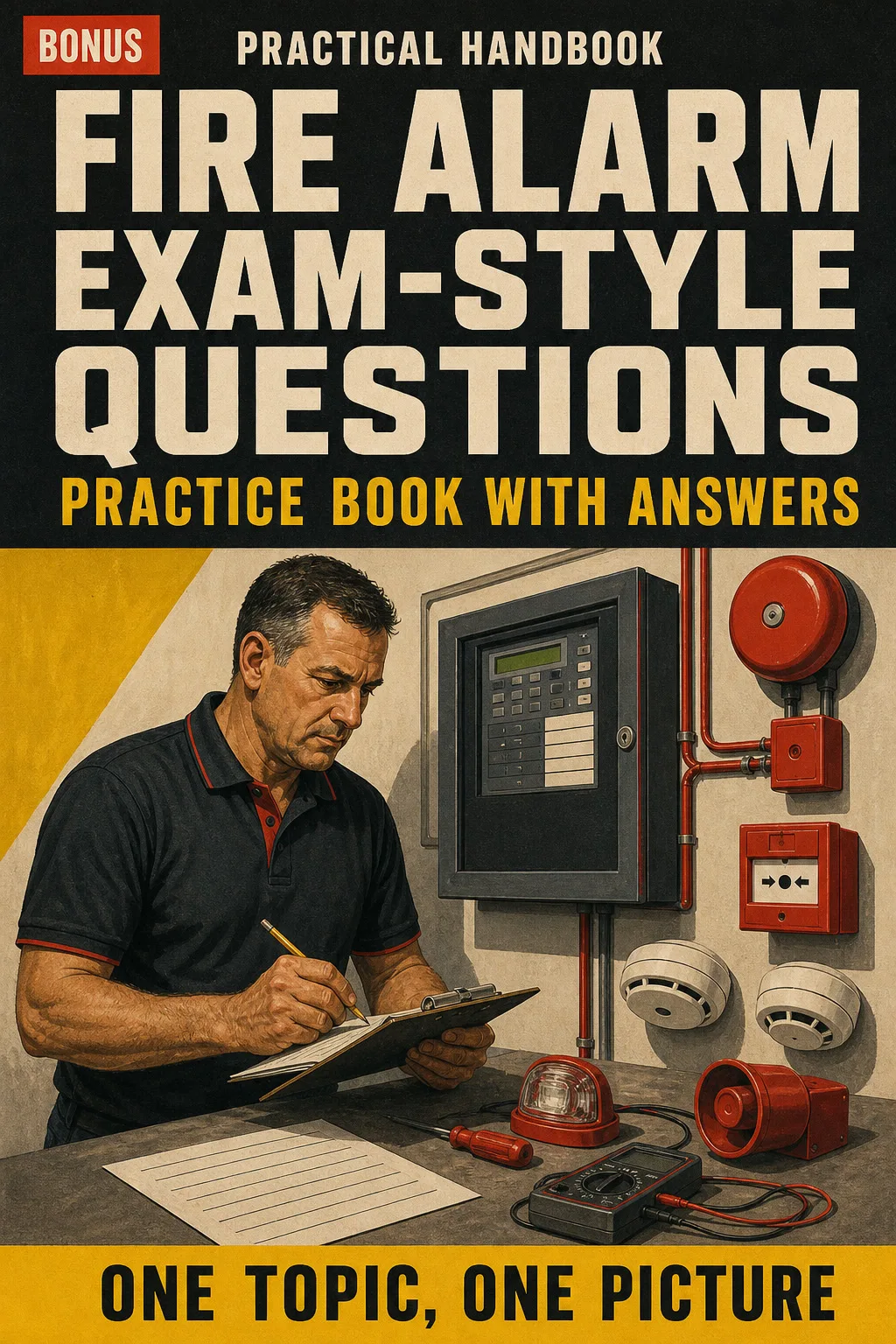
Fire Alarm Exam-Style Questions: Practice Book with Answers

BONUS 1: «Fire Alarm Exam-Style Questions: Practice Book with Answers»

Value on its own: US$ 17.90

Test yourself on detectors, spacing, zones, batteries and commissioning, with every answer explained so you know why, not just what.

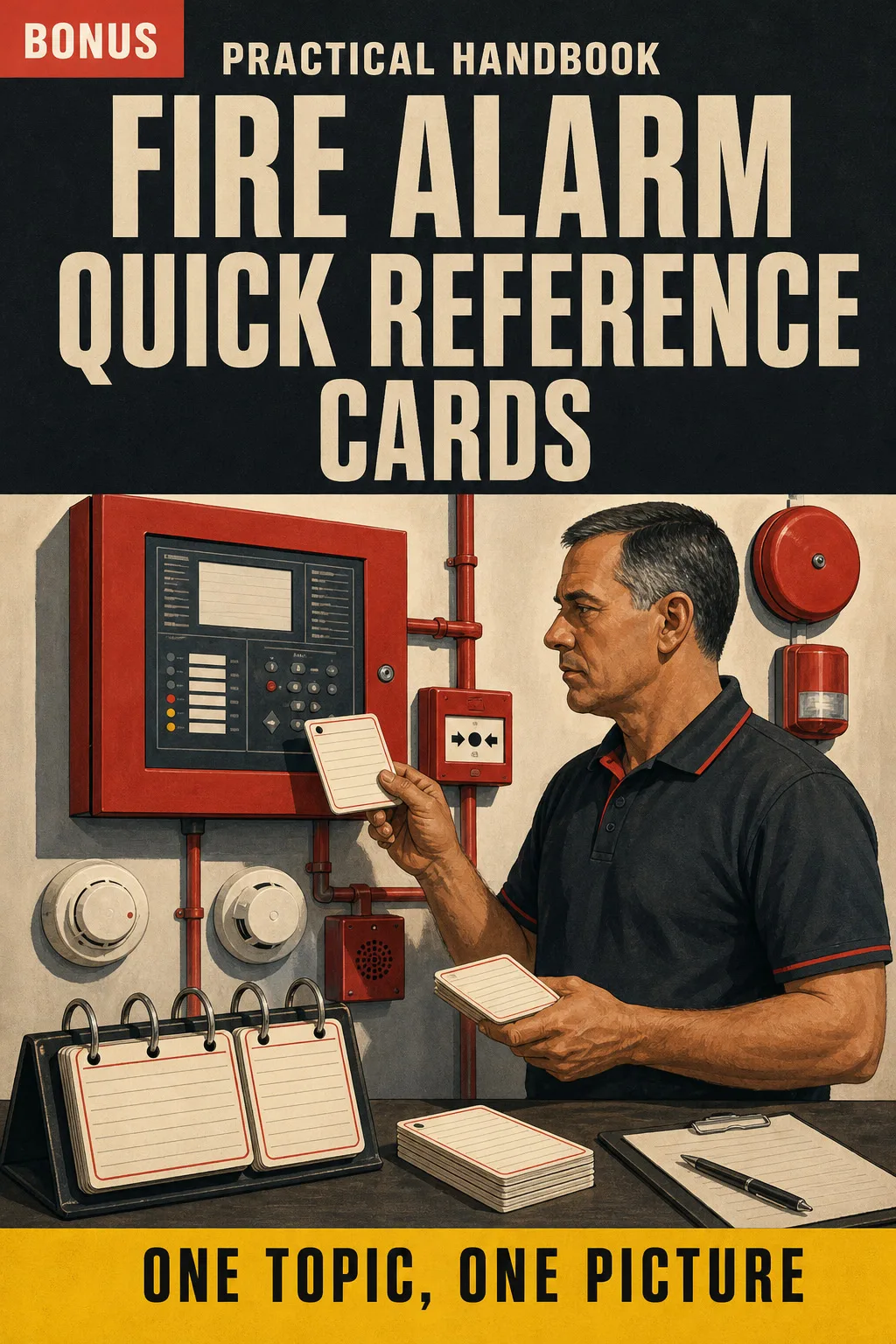
Fire Alarm Quick Reference Cards

BONUS 2: «Fire Alarm Quick Reference Cards»

Value on its own: US$ 14.90

The distances, heights, sound levels and battery formula you look up most, on printable cards to revise in minutes or keep in the van.

Fire Alarm Systems Illustrated with 2 Free Books

  • Fire Alarm Systems Illustrated: 65 illustrated pagesUS$ 63
  • BONUS 1: Fire Alarm Exam-Style Questions: Practice Book with AnswersUS$ 17.90
  • BONUS 2: Fire Alarm Quick Reference CardsUS$ 14.90
  • High-resolution PDF to printIncluded
Total value US$ 95.80
YOUR PRICE:
US$ 27
You save US$ 68.80
YES, I WANT FIRE ALARM SYSTEMS ILLUSTRATED FOR US$ 27

📄 This is a digital PDF book sent to your email: nothing is printed or shipped.

Secure purchaseEncrypted payment30-day guarantee

PDF by email: We email you Fire Alarm Systems Illustrated as a PDF, together with the two free books. It's a single payment: no installments, no extra charges.

Who This Book Is For

You're studying for SAQCC Fire registration

You're studying for SAQCC Fire registration

Every rule you use on site becomes a drawing with the measurement marked, so the evening's study turns into pictures you can recall.

Your assessment is coming up

Your assessment is coming up

The calculations and the fault finding come in fixed steps, always in the same order, so you can explain what you do instead of going blank.

You already work in fire detection

You already work in fire detection

A printable reference for the van: spacing, call point heights, cable and batteries at a glance, before you open the standard.

Everything You Get Today

US$ 95.80US$ 27
YES, I WANT FIRE ALARM SYSTEMS ILLUSTRATED FOR US$ 27

📄 This is a digital PDF book sent to your email: nothing is printed or shipped.

30DAYS
GUARANTEE

30-Day Guarantee

Try Fire Alarm Systems Illustrated for 30 days, bonus books included.

We refund everything if the file won't open, if the book isn't what you see here, if you were charged twice or if the email doesn't arrive. Just email us.

You pay once. No subscriptions.

Frequently Asked Questions

Is it for me if I've been installing for years and now need SAQCC Fire registration?

Yes. It isn't a beginner's book: it puts what you already do on site in order, one topic per page, from detector spacing to the Ah calculation and fault finding, so you can explain it to an assessor or a client. It's useful revision whether you're going for installer, commissioner or designer registration, or studying for the Fire Alarm Designer occupational certificate.

Where does the content come from?

It's written for South African work, around SANS 10139, SANS 10400-T and SANS 322 and the SAQCC Fire registration categories, in metric units. It isn't a UK or US book with other distances. Everything is explained in our own words and drawings: no text or tables from the standards are reproduced, so always check the current edition.

Is it official material?

No. It's independent study material, not issued or endorsed by SAQCC Fire, the SABS or any other body.

Does it replace the course or the standard?

No. It helps you study and revise, but it doesn't replace accredited training, supervised site work or the standard itself. It doesn't come with a certificate and it doesn't guarantee SAQCC Fire registration or passing an assessment.

Are the practice questions the ones in the exam?

No. They're written for this book to help you practise, and they aren't official questions from any exam or assessment.

When and how does it arrive?

As a PDF by email, to the address you enter at checkout, together with the 2 gift books.

Do I have to pay every month?

No. It's a one-off payment, with no subscription.

Is it a PDF or a printed book?

It's a PDF, sent by email. It's ready to print on A4, so you can keep it in the van or take it to site.

How does the refund work?

You have 30 days. We refund everything if the file won't open, if the book isn't what you see on this page, if you were charged twice or if the email doesn't arrive: just email us.

Before You Close This Page

No more rereading with nothing sticking.

The coverage circle and the battery steps: you see them drawn, and that's it.

You walk into the assessment knowing where everything is.

Drawings make studying faster.

The book is right below.

One-time payment: US$ 27 · Guarantee: 30 days · PDF by email

YES, I WANT FIRE ALARM SYSTEMS ILLUSTRATED FOR US$ 27

📄 This is a digital PDF book sent to your email: nothing is printed or shipped.